
Awareness vs Conversion in Retail Marketing


Most marketing today is built around one idea.
Drive awareness.Generate interest.Convert the customer.
It sounds simple.
But in reality, these steps don’t happen in the same place.
Where Awareness Is Built
Think about how most brands reach consumers today.
Social media ads. Search campaigns. Video platforms.
These channels are excellent at building awareness.
They introduce the product.Shape perception.Create intent.
A consumer might see an ad for a snack, a shampoo, or a beverage while scrolling.
They may not act immediately.
But the idea stays with them.
Where Conversion Actually Happens
Now think about where the purchase happens.
In many categories, especially FMCG, it still happens inside a store.
According to insights from NielsenIQ, a significant majority of purchases in these categories continue to take place in physical retail environments.
This is where the journey shifts.
The consumer is no longer just aware.
They are deciding.
Standing in front of a shelf.Comparing options.Making a choice in seconds.
The Disconnect in Marketing
Here’s where things get interesting.
Most marketing budgets are heavily focused on building awareness online.
But the final decision often happens offline.
This creates a gap.
Brands invest in generating demand in one environment,but often have limited presence where that demand converts.
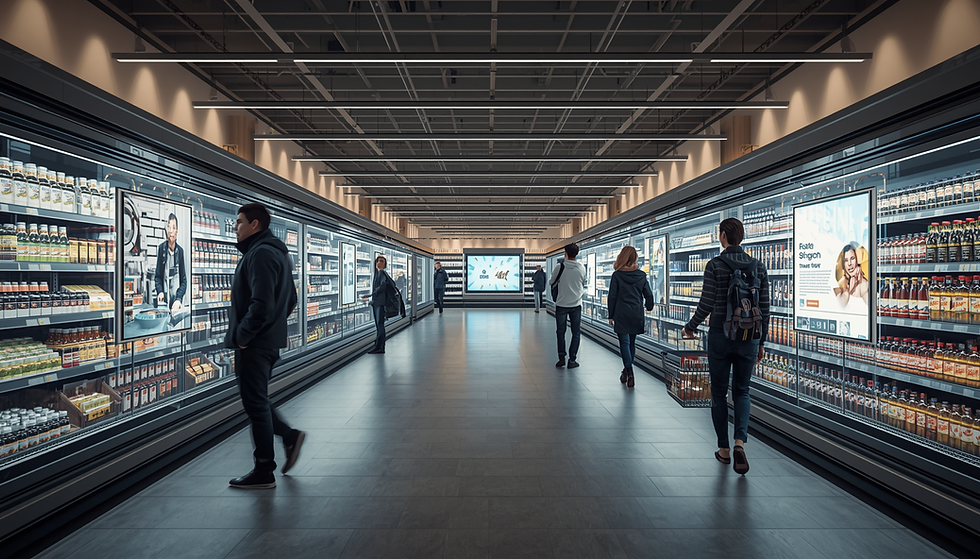
The Store as the Conversion Layer
If digital channels are building intent,stores are where that intent is realized.
Inside the aisle:
the shopper is physically present
the product is right in front of them
alternatives are visible
and the decision happens instantly
This makes the store a conversion layer in the marketing funnel.
Not just a distribution point.
Why This Matters More Than Ever
As digital advertising becomes more competitive and expensive,the cost of building awareness continues to rise.
At the same time, attention online is fragmented.
People scroll quickly.Skip ads.Divide focus.
Inside a store, the situation is very different.
The shopper is:
focused
closer to purchase
and actively evaluating options
This makes in-store environments uniquely powerful for conversion.
Connecting Awareness to Action
The most effective marketing strategies don’t treat channels in isolation.
They connect them.
A consumer sees a product online.Walks into a store later.And encounters the same brand again at the shelf.
That reinforcement matters.
Because decisions are often not made in a single moment.
They are shaped across multiple touchpoints.
Rethinking the Funnel
Traditionally, the funnel is visualized as:
Awareness → Consideration → Conversion
But in retail, it often looks more like this:
Online → Awareness & IntentIn-Store → Decision & Conversion
Understanding this shift changes how brands should think about media.
It’s not just about reaching consumers.
It’s about being present when the decision is made.
The Opportunity for Brands
For marketers, this raises an important question.
If awareness is being built digitally,and conversion is happening physically,
are both environments being connected effectively?
Because the brands that win are not just the ones that create demand.
They are the ones that capture it at the right moment.
Final Thought
Marketing does not end when a consumer enters a store.
In many cases, that is where it becomes most important.
Because awareness may start the journey.
But conversion is what completes it.
References
NielsenIQ. Retail and shopper behavior insights
Deloitte. The Changing Consumer Purchase Journey
McKinsey & Company. The Future of Retail and Omnichannel Commerce


Comments