
The Last 5 Seconds Before a Purchase: Where In-Store Media Can Change the Decision

A shopper walks into a grocery store with a simple goal.
Buy shampoo. Buy snacks. Buy something for dinner.
They walk through aisles filled with hundreds of products. Most of these products have already spent millions on advertising. TV campaigns, social media ads, influencer collaborations, and billboards have all played their part.
But surprisingly, the most important marketing moment has not happened yet.
It happens in the last few seconds before the product goes into the cart.
That small moment at the shelf is where decisions quietly shift.
And it is where brands either win or lose.

The “Moment of Truth” in Retail
Retail researchers often refer to this as the First Moment of Truth (FMOT). The term was popularized by Procter & Gamble to describe the few seconds when a shopper stands in front of the shelf deciding what to buy.
The typical shopper spends between 3 and 7 seconds evaluating products before making a decision.
Think about that.
Years of brand building often come down to a few seconds in front of a shelf.
During this time the brain is processing several signals:
visual cues
price
familiarity
placement
promotions
packaging
and sometimes the influence of nearby messaging
This is where psychology takes over.
The Brain Loves Shortcuts
Human beings rarely make fully rational decisions while shopping.
Our brains rely on mental shortcuts called heuristics. These help us make quick decisions without evaluating every option.
Behavioral economist Daniel Kahneman explains this in his book Thinking, Fast and Slow. He describes how our brain uses fast thinking for everyday decisions.
Shopping inside a store is a perfect example of fast thinking.
The shopper is not running a detailed analysis of ingredients or value per gram. Instead the brain looks for quick signals:
“I recognize this brand.”
“This looks premium.”
“This feels like a better option.”
“This one caught my attention.”
Often the product that captures attention first gets the advantage.
Why Attention Is the Real Currency in Stores?
A typical supermarket aisle can contain over 200 competing products within a single category.
From the shopper’s perspective, this creates a problem.
Too many choices.
Psychologist Barry Schwartz describes this phenomenon in The Paradox of Choice. When people face too many options, they often simplify their decision process.
Instead of evaluating everything, they focus on the few products that capture their attention first.
This means something important for brands.
Winning inside a store is not about being present. It is about being noticed at the right moment.
What Actually Influences the Final Decision
Retail studies consistently show that a significant percentage of purchase decisions happen inside the store rather than before entering it.
Research from shopper marketing studies indicates that many consumers switch brands at the shelf even if they walked in with a preferred option in mind.
Why does this happen?
ecause the environment around the shopper is influencing them in real time.
Small triggers can shift decisions:
a visual display
a promotional sign
a recommendation
a reminder of the brand
a cue that reinforces familiarity
These cues work because they appear right at the moment the brain is making a choice.
The Power of Context
Advertising works best when it appears in the right context.
A coffee ad shown while someone is scrolling social media is one thing.
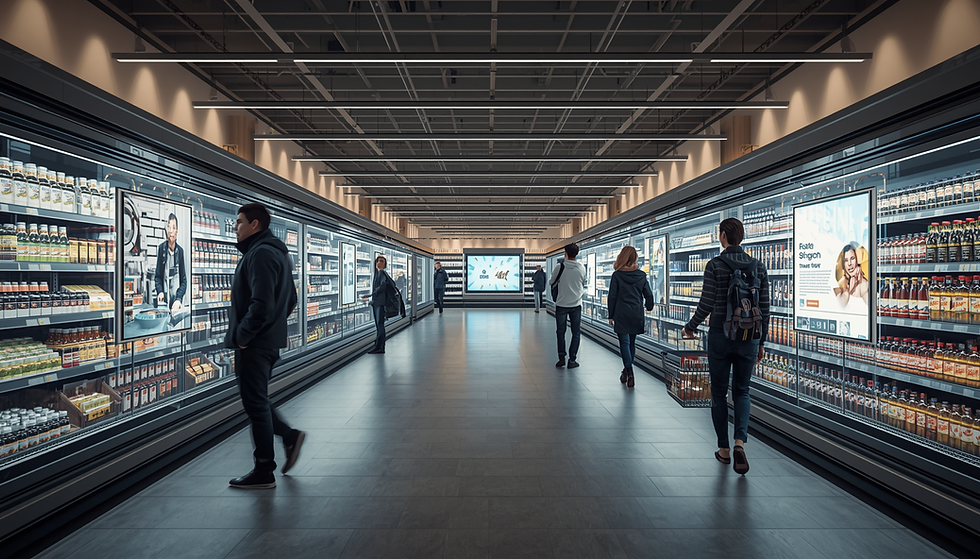
But a coffee message seen while standing in the beverage aisle is something very different.
At that moment the brain is already thinking about the purchase.
This is why proximity matters in retail marketing.
The closer a message is to the decision point, the more influence it can have.
Not because it forces the shopper to buy something.But because it enters the decision process at the exact moment it is happening.
The Shelf Is the Most Competitive Advertising Space
If you think about it, the store shelf might be the most competitive advertising space in the world.
Every brand is fighting for the same thing:
attention in those final seconds.
And attention inside stores behaves differently from attention online.
Shoppers are not scrolling.
They are moving through aisles, making quick choices, and trying to finish their shopping efficiently.
Which means brands have a very small window to influence the outcome.
Often just a few seconds.
The Real Opportunity for Brands
Most marketing strategies focus heavily on the journey before the store.
Digital ads drive awareness. Social media creates interest. Search influences intent.
All of that is important.
But the story is not complete until the shopper stands in front of the shelf.
Because that is where intent becomes action.
And sometimes the difference between winning and losing that sale comes down to the last five seconds.
References
Procter & Gamble. First Moment of Truth (FMOT) Shopper Research
Daniel Kahneman. Thinking, Fast and Slow. Farrar, Straus and Giroux.
Barry Schwartz. The Paradox of Choice. HarperCollins.
Shopper Marketing studies referenced in retail behavior research by Deloitte and Nielsen.


Comments